
Soluble Protein Technology
Construct optimization, multi-host expression screening (bacterial, insect, mammalian), multi-step FPLC purification, and rigorous biophysical quality assessment for research, structural biology, and assay development.
How Soluble Proteins Are Made
A gene encoding the target protein is placed into an expression vector and introduced into a suitable host. The host cell reads the recombinant gene and produces the protein. The product is then recovered from the culture medium or from lysed cells, depending on whether it is secreted or retained inside the cell. Purification normally begins with selective capture and continues through one or more polishing steps.
Why Expression Host Selection Matters
E. coli can provide rapid and economical production for many relatively simple proteins. Sf9 insect cells support more complex folding and some post-translational processing. Expi293F mammalian cells are useful when human-like folding, secretion, glycosylation, or other mammalian processing is important. The host is chosen according to protein complexity and downstream use.
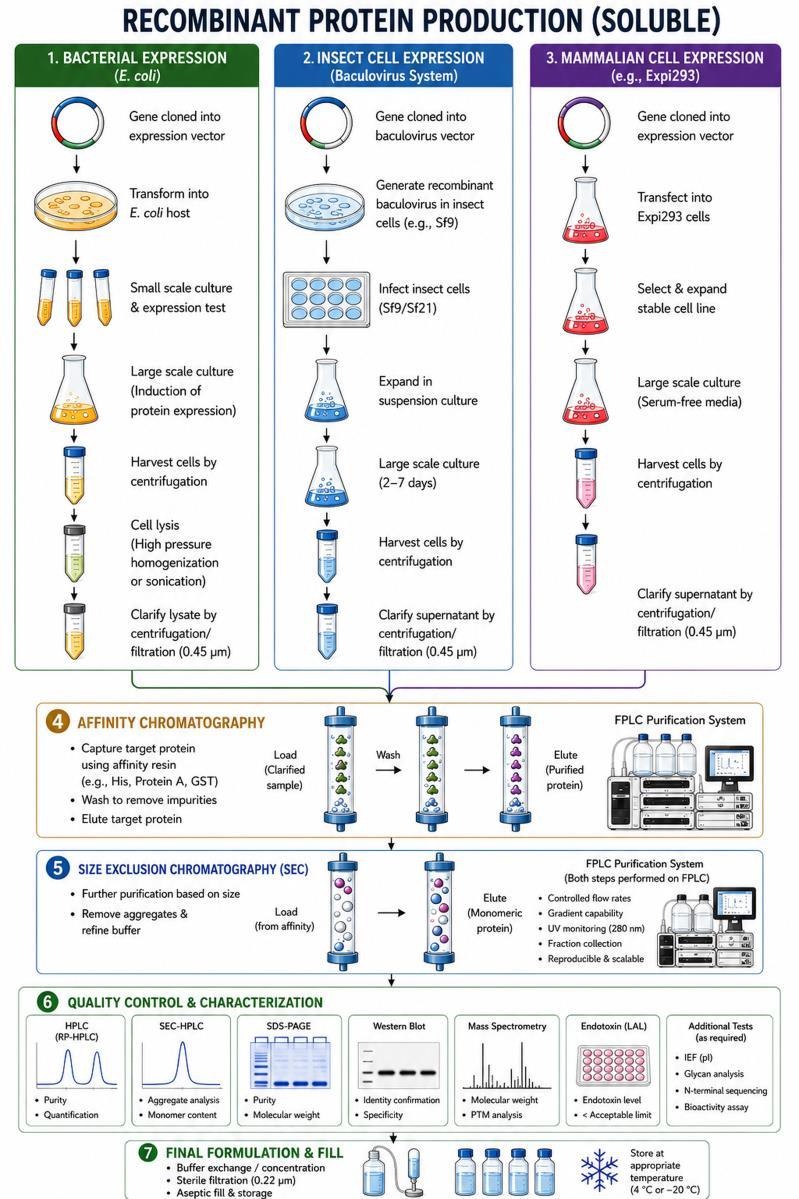
End-to-End Pipeline
Stages of Soluble Protein Production
From gene synthesis and construct design to multi-modal chromatographic polishing.
Target and construct design
Expression-system selection
Small-scale expression screening
Scale-up and culture
Harvest and product recovery
Clarification and initial capture
FPLC purification and polishing
Buffer exchange, formulation, and QC
Target and construct design
The sequence is reviewed for domain boundaries, signal peptides, transmembrane regions, disordered segments, cleavage sites, oligomerization domains, and purification tags. Several constructs may be designed when the optimal boundaries are uncertain.
Target and construct design
The sequence is reviewed for domain boundaries, signal peptides, transmembrane regions, disordered segments, cleavage sites, oligomerization domains, and purification tags. Several constructs may be designed when the optimal boundaries are uncertain.
From Purified Protein to an Application-Ready Preparation
Purification is not complete when the final chromatography peak is collected. The protein must be placed into a buffer that supports its intended concentration, handling, storage, and assay conditions without causing precipitation, aggregation, or loss of activity.
Expression Hosts
Our Expression Platforms
Matched to molecular complexity, folding requirements, and application goals.
E. coli
Rapid Bacterial Expression
Useful for many non-glycosylated proteins, enzymes, domains, antigens, and screening constructs. It supports fast iteration and straightforward scale-up, but complex disulfide bonding or mammalian post-translational processing may be limited.
Sf9
Baculovirus-Insect Expression
Supports proteins that are difficult to fold in bacteria and can provide eukaryotic processing. It is useful for many structural and functional proteins that require a eukaryotic host but do not require fully human processing.
Expi293F
Mammalian Expression
Supports human-like folding, secretion, glycosylation, and assembly for complex recombinant proteins. It is often selected for receptors, extracellular domains, antibodies, and proteins whose activity depends on mammalian processing.
Platform Foundations
Technical Basis Behind the Platform
Five engineering principles ensuring reliable, active, and monodisperse recombinant protein delivery.
Construct design before scale-up
Domain boundaries, tags, signal peptides, linkers, and secretion design can determine whether a protein is soluble and functional. Early construct screening reduces the risk of scaling an unsuitable design.
Host matched to molecular complexity
The production route is selected according to folding, solubility, disulfide bonding, oligomerization, and post-translational modification requirements.
Orthogonal FPLC purification
Affinity capture, ion-exchange separation, and size-exclusion polishing resolve different impurity classes and improve confidence in final homogeneity.
Monodisperse preparations for demanding studies
Structural biology and quantitative interaction studies often require removal of aggregates and heterogeneous populations, not simply a high total-protein concentration.
Function confirmed after purification
Binding or activity testing verifies that the purification process preserved the property that makes the target useful.
Building Performance into Every Protein
Protein performance is shaped by the construct, host, purification process, and final formulation. These variables are planned together so that improvements in yield do not come at the expense of folding, homogeneity, or activity.
| Design or Process Variable | Examples | Why It Matters |
|---|---|---|
| Construct boundaries | Full-length protein, catalytic domain, extracellular domain, truncation variants | Removing unstable or disordered regions can improve expression and solubility while preserving the required function. |
| Purification tags | His, Strep, Fc, GST, or project-specific tags | Tags support selective capture but may affect folding, oligomerization, assay performance, or final product design. |
| Secretion design | Native or engineered signal peptides | Secreted recovery can simplify purification and support extracellular disulfide formation or glycosylation. |
| Expression host | E. coli, Sf9, Expi293F | The host determines folding environment, processing, speed, scale, and many product-quality attributes. |
| Buffer and additives | pH, salt, glycerol, cofactors, reducing agents, stabilizers | Formulation conditions influence solubility, activity, aggregation, and storage stability. |
| Final molecular state | Monomer, defined oligomer, complex, or tagged reagent | The desired state must be distinguished from aggregates or unintended assemblies during polishing and QC. |
| Analytical plan | SDS-PAGE, HPLC, SEC-MALS, DLS, mass analysis, functional assays | Orthogonal methods confirm that the protein is the correct molecule and behaves as required. |
Purification and Formulation Strategy
Capture
The initial step enriches the target from the clarified feed. Affinity tags or natural binding interactions provide strong selectivity and reduce the burden on later polishing steps.
Polishing
Ion-exchange and size-exclusion chromatography can remove remaining contaminants, charge variants, aggregates, fragments, and incorrectly assembled species. The sequence of operations is adjusted for the target protein.
Final Formulation
The protein is transferred into a buffer compatible with the planned assay, concentration, shipping, and storage conditions. Buffer screening may be needed when the protein loses activity or aggregates after purification.